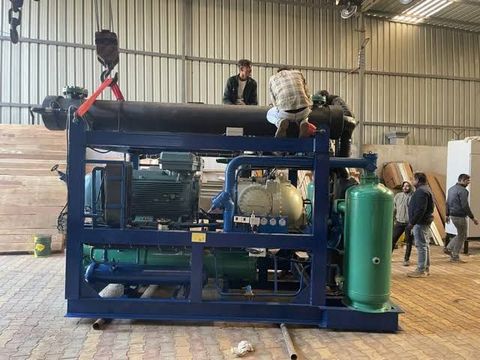
Industrial Evaporative Cooling Systems: Working, Applications, Benefits, and Limitations
Introduction Industrial facilities generate significant amounts of heat through manufacturing equipment, refrigeration processes, compressors, furnaces, data-processing equipment, and other operations. Removing this heat efficiently is important for maintaining equipment performance, product quality, workplace conditions, and process stability. One technology used for this purpose is the industrial evaporative cooling system. Industrial evaporative cooling systems use the natural cooling effect that occurs when water evaporates. Instead of relying entirely on mechanical refrigeration, these systems transfer heat from air or process fluids and use evaporation to reject that heat. Depending on the design, an evaporative system can cool process water, equipment, machinery, or large industrial spaces. These systems are different from conventional air-conditioning equipment. A typical air conditioner uses a refrigeration cycle to remove heat, while evaporative cooling uses water evaporation as a major part of the heat-transfer process. This distinction makes evaporative cooling particularly relevant for facilities located in climates where conditions are suitable for evaporation. The term swamp cooler is commonly associated with smaller evaporative air coolers. Searches for wamp cooler and AC or "swamp cooler and air conditioner" often reflect comparisons between evaporative cooling and conventional refrigeration-based air conditioning. Industrial systems, however, are generally larger, more engineered installations designed around specific heat loads, water conditions, airflow requirements, and operating environments.
Main Types of Industrial Evaporative Cooling Systems
Industrial cooling systems are available in several configurations. The right type depends on whether the facility needs process-fluid cooling, air cooling, heat rejection, or a combination of these functions.
| System type | Basic principle | Typical applications | Main consideration |
|---|---|---|---|
| Open-circuit cooling tower | Water is directly exposed to moving air | Manufacturing, power, process cooling | Water treatment and evaporation losses |
| Closed-circuit fluid cooler | Process fluid remains inside coils | Industrial processes, HVAC, data centers | Higher equipment complexity |
| Direct evaporative cooler | Air passes over wetted media | Warehouses, workshops, industrial spaces | Adds moisture to air |
| Indirect evaporative cooler | Evaporative cooling occurs without directly humidifying the supply air | Industrial ventilation, data centers | More complex heat exchanger arrangement |
| Hybrid cooling system | Combines evaporative and dry cooling | Facilities with changing weather conditions | Higher initial complexity |
| Evaporative condenser | Uses evaporation to reject refrigeration-system heat | Industrial refrigeration | Requires careful water management |
Industrial cooling towers are among the most recognizable examples. They are widely used where large quantities of heat must be rejected continuously.
Applications of Industrial Evaporative Cooling
Industrial evaporative cooling can be used in many environments where heat rejection is a major operational requirement.
Manufacturing
Manufacturing facilities may use evaporative systems to cool machinery, hydraulic equipment, process water, compressors, and other heat-generating equipment.
Power Generation
Power plants and energy facilities can require substantial heat rejection capacity. Cooling towers are often integrated into larger cooling-water systems to remove heat from condensers and related equipment.
Chemical and Process Industries
Chemical processing can involve reactions and equipment that generate considerable heat. Evaporative cooling can provide process-water cooling when the required temperatures and site conditions are suitable.
Food and Beverage Processing
Temperature control is important in food production. Cooling systems may be used for process equipment, refrigeration systems, storage areas, and production environments.
Data Centers
Data centers generate continuous heat from computing equipment. Evaporative or hybrid cooling can be integrated with chilled-water, air-handling, or heat-rejection systems depending on the facility design.
Warehouses and Industrial Buildings
Direct evaporative coolers can provide ventilation and temperature reduction in large spaces where maintaining very low indoor temperatures is not necessary.
Benefits of Industrial Evaporative Cooling
Energy Efficiency Potential
Because evaporation performs a significant portion of the heat-transfer work, some systems can reduce dependence on compressor-based refrigeration. Energy performance depends on design, climate, fan and pump operation, and required leaving-water or air temperatures.
Suitable for Large Heat Loads
Cooling towers and evaporative fluid coolers can handle substantial heat loads, making them useful for large industrial facilities.
Lower Refrigeration Dependence
Evaporative systems can sometimes provide cooling without using a conventional vapor-compression refrigeration cycle. This can be useful where the application does not require refrigeration-level temperatures.
Flexible System Configurations
Facilities can select open, closed-circuit, direct, indirect, dry, or hybrid configurations depending on their process requirements.
Potentially Compact Heat Rejection
Evaporative heat rejection can achieve significant thermal performance within a relatively compact footprint compared with some dry cooling arrangements, although the actual footprint depends on capacity and design.
Limitations and Challenges
Evaporative cooling is not automatically the best solution for every industrial application.
Water Consumption
Water is an essential operating resource for most evaporative systems. Evaporation, blowdown, drift, and other losses must be considered when estimating water demand.
Water Quality Management
Minerals and contaminants can become concentrated as water evaporates. Without proper treatment and monitoring, scale, corrosion, fouling, and biological growth can affect equipment performance.
Facilities often work with specialized cooling tower treatment companies or water-treatment professionals to establish appropriate treatment programs.
Humid Climate Performance
High outdoor humidity reduces the air's ability to absorb additional moisture. This can make direct evaporative cooling less effective during humid weather.
Maintenance Requirements
Fans, pumps, fill material, nozzles, basins, coils, filters, and water-treatment equipment all require inspection and maintenance.
Biological Risk
Poorly maintained water systems can create conditions that support unwanted biological growth. Water management, cleaning, disinfection where appropriate, and adherence to applicable regulations are important parts of responsible operation.
Key Features to Consider
Before selecting an evaporative cooling system, facility managers should evaluate more than nominal cooling capacity.
1. Heat Load
Determine the amount of heat that must be rejected under normal and peak operating conditions.
2. Entering and Leaving Temperatures
The required process-fluid temperature and acceptable temperature range directly influence equipment selection.
3. Wet-Bulb Temperature
For evaporative equipment, outdoor wet-bulb temperature is an important design parameter because it affects the theoretical cooling limit.
4. Water Availability
Evaluate the quality, quantity, cost, and reliability of available water.
5. Water Treatment
Consider filtration, chemical treatment, monitoring, blowdown control, and corrosion or scale management.
6. Noise
Fans and pumps can produce significant sound. Noise requirements should be considered during site planning.
7. Footprint and Access
Leave sufficient space for installation, inspection, cleaning, repairs, and component replacement.
8. Controls
Modern systems may use sensors and automated controls to adjust fans, pumps, water flow, and operating modes according to changing conditions.
Industrial Evaporative Cooling Compared With Other Options
| Factor | Evaporative cooling | Conventional AC/chiller | Dry cooling |
| Main cooling principle | Water evaporation | Refrigeration cycle | Air-to-fluid heat transfer |
| Water requirement | Usually required | Usually lower at equipment level | Minimal or none |
| Humidity sensitivity | Higher | Lower | Lower |
| Refrigerant required | Not necessarily | Generally yes | Not necessarily |
| Maintenance focus | Water, fans, pumps, heat-transfer surfaces | Refrigeration circuit, compressors, coils | Fans, coils, heat-transfer surfaces |
| Large heat-load suitability | High for suitable applications | High | High, but performance depends on ambient conditions |
| Typical concern | Water quality and availability | Energy and refrigeration equipment | High ambient-temperature performance |
Portable industrial chiller units are another option when a facility needs temporary or localized chilled-water capacity. They may be useful for short-term production requirements, equipment testing, maintenance situations, or facilities where permanent cooling infrastructure is not practical. However, they should be evaluated based on the required temperature, flow rate, heat load, electrical capacity, and operating duration.
Top Companies and Solution Providers
Several established manufacturers provide evaporative cooling equipment for industrial and process applications. These companies offer different product families, so a brand comparison should focus on application requirements rather than assuming that one manufacturer is universally better.
- EVAPCO provides evaporative, dry, adiabatic, hybrid, cooling tower, condenser, and closed-circuit cooler solutions for industrial process applications. Its portfolio covers industrial process cooling, refrigeration, data centers, and other applications. EVAPCO official website
- SPX Cooling Technologies, including Marley, Recold, and SGS brands, provides cooling towers, evaporative fluid coolers, evaporative condensers, adiabatic systems, and industrial process cooling solutions. Its portfolio includes both factory-assembled and field-erected systems. SPX Cooling Technologies official website
- Munters offers direct and indirect evaporative cooling equipment, evaporative media, precooling systems, and other industrial cooling technologies for manufacturing, data centers, storage, and other environments. Munters official website
- Baltimore Aircoil Company (BAC) is another established manufacturer in evaporative heat-transfer equipment and cooling technologies. When comparing suppliers, users should review current technical documentation, local support, certification, water-management features, and application experience rather than relying only on brand recognition.
Latest Trends and Innovations
The industrial cooling sector is increasingly focused on reducing water and energy consumption while maintaining reliable heat rejection.
Hybrid Cooling
Hybrid systems combine evaporative and dry cooling approaches. They can operate in different modes depending on ambient conditions and water availability.
Automated Water Management
Sensors and controls can monitor conductivity, temperature, water levels, and other operating parameters. Automated control can help maintain appropriate water chemistry and reduce unnecessary water use.
Improved Heat-Transfer Designs
Manufacturers continue to develop improved coils, fill materials, fans, and airflow arrangements to increase heat-transfer performance while managing equipment size and energy consumption.
Adiabatic Cooling
Adiabatic systems use controlled water evaporation to precool air before it passes through a dry heat exchanger. This approach can provide a balance between dry operation and evaporative performance.
Digital Monitoring
Remote monitoring and connected controls can provide information about temperature, vibration, fan operation, water conditions, and maintenance requirements. These systems can help operators identify abnormal conditions earlier.
How to Choose the Right System
Use this checklist before selecting equipment:
Calculate normal and peak heat loads.
Identify required entering and leaving temperatures.
Obtain local design dry-bulb and wet-bulb conditions.
Check available water quantity and quality.
Estimate evaporation and blowdown requirements.
Determine acceptable noise levels.
Review available electrical capacity.
Confirm installation footprint and service access.
Establish a water-treatment strategy.
Check applicable environmental, building, and water regulations.
Compare lifecycle cost rather than purchase price alone.
Confirm local technical support and spare-parts availability.
Evaluate whether an open, closed, dry, or hybrid system better fits the process.
A detailed engineering assessment is especially important for large process-cooling installations. The system should be selected around actual operating conditions rather than simply choosing a unit based on nominal capacity.
Tips for Better Operation and Maintenance
Regular maintenance is essential for maintaining heat-transfer performance.
Inspect water distribution systems and nozzles for blockage. Check pumps and fans for unusual vibration, noise, or changes in performance. Keep heat-transfer surfaces and fill material reasonably clean. Monitor water chemistry according to the site's treatment program.
Operators should also watch for unexpected changes in approach temperature, pressure drop, water consumption, fan energy, or pump performance. These changes can indicate fouling, scaling, airflow problems, mechanical wear, or other issues.
Keep maintenance records for inspections, water treatment, cleaning, component replacement, and performance checks. A documented maintenance history makes it easier to identify gradual performance changes.
Frequently Asked Questions
Is an evaporative cooler the same as a swamp cooler?
The underlying evaporation principle is similar, but the scale and engineering can be very different. A swamp cooler is generally a small direct evaporative air cooler, while industrial evaporative cooling equipment can include large cooling towers, closed-circuit fluid coolers, evaporative condensers, and engineered process-cooling systems.
Is evaporative cooling better than air conditioning?
Neither is universally better. Evaporative cooling can be suitable where climate, water availability, and temperature requirements support it. Conventional air conditioning is generally more suitable when precise temperature and humidity control is required or when outdoor humidity is high.
Does industrial evaporative cooling use a lot of water?
Water use varies considerably by system type, capacity, climate, operating hours, cycles of concentration, and water-management practices. Water consumption should be calculated during system selection rather than estimated from equipment size alone.
Can evaporative cooling work in humid areas?
It can, but performance may be reduced because humid air has less capacity to absorb additional moisture. Indirect, hybrid, or dry cooling configurations may be worth evaluating when humidity is a major concern.
Are cooling towers difficult to maintain?
They require regular attention to water quality, mechanical components, heat-transfer surfaces, and cleanliness. A planned maintenance and water-management program can help keep the system operating reliably.
When should a facility consider portable industrial chiller units?
Portable chillers can be useful when cooling is temporary, localized, or needed during maintenance or expansion. They are not necessarily a replacement for a permanent evaporative system and should be compared based on capacity, temperature requirements, flow rate, operating time, and infrastructure.
Conclusion
Industrial evaporative cooling systems provide an important method of rejecting heat in manufacturing, processing, refrigeration, power, data center, and other industrial environments. Their main advantage is the ability to use evaporation as part of the heat-transfer process, potentially providing efficient cooling for substantial heat loads.
At the same time, evaporative systems require careful consideration of water availability, water chemistry, climate, maintenance, biological control, noise, and site conditions. An open cooling tower, closed-circuit cooler, direct evaporative cooler, hybrid system, or dry alternative can each make sense in different circumstances.
The practical takeaway is that selecting an industrial cooling system should begin with the process requirements, not the equipment label. Understanding heat load, climate, water conditions, temperature targets, maintenance needs, and lifecycle costs provides a stronger foundation for choosing a system that can operate effectively over the long term.

Related Post...
Guide tof High-Pressure Water Pump Systems: Types, Applications, and Considerations
Updated: October 17, 2026
Read More