A Complete Guide to HVAC Cooling Systems, Types, Components, and Applications
Heating, ventilation, and air conditioning (HVAC) systems play an important role in maintaining comfortable indoor environments. They regulate temperature, manage airflow, support indoor air quality, and help control humidity in residential, commercial, and industrial buildings. HVAC cooling systems are particularly important in regions with hot climates, where indoor temperatures can affect comfort, productivity, equipment performance, and certain manufacturing processes. HVAC cooling technology includes several system types, ranging from conventional split air conditioners to large central cooling installations used in offices, hospitals, shopping centers, and industrial facilities. Each system operates differently and has its own installation requirements, operating costs, maintenance needs, and performance characteristics. Understanding how HVAC cooling systems work can help homeowners, facility managers, engineers, and business owners make informed decisions. This guide explains the main types of HVAC cooling systems, their components, advantages, limitations, applications, and maintenance requirements.
What Is an HVAC Cooling System?
An HVAC cooling system removes unwanted heat from an indoor space and transfers it to the outdoor environment or another suitable heat-rejection source. Depending on the system design, it may also regulate humidity, filter airborne particles, and distribute conditioned air throughout a building.
Most conventional air conditioning systems use a refrigeration cycle. A refrigerant absorbs heat as it evaporates at low pressure and releases heat as it condenses at higher pressure. A compressor, evaporator, condenser, and expansion device work together to circulate the refrigerant and maintain the cooling process.
However, not every HVAC cooling system uses the same technology. Some buildings use chilled water distributed from a central chiller, while others rely on direct-expansion equipment or evaporative cooling.
HVAC cooling systems are commonly used in homes, offices, hotels, educational institutions, healthcare facilities, data centers, warehouses, and manufacturing plants.
How Do HVAC Cooling Systems Work?
The operating process depends on the system type, but a conventional vapor-compression air conditioner follows several basic steps.
Heat absorption: The indoor evaporator absorbs heat from the air passing over its coil.
Refrigerant compression: The compressor raises the refrigerant's pressure and temperature.
Heat rejection: The condenser transfers heat to outdoor air or cooling water.
Pressure reduction: An expansion device reduces the refrigerant pressure before it returns to the evaporator.
Air distribution: A fan or blower circulates cooled air through the room or ductwork.
This cycle repeats as needed to maintain the selected temperature.
A cooling system does not eliminate heat; it moves heat from one location to another. Its performance depends on outdoor conditions, system sizing, airflow, refrigerant charge, insulation, maintenance, and operating settings.
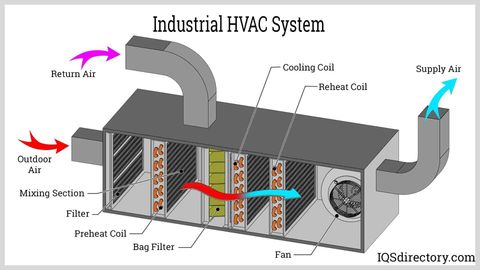
Main Components of HVAC Cooling Systems
Each component performs a specific function. Understanding these parts makes it easier to recognize maintenance requirements and compare system designs.
| Component | Primary Function |
|---|---|
| Compressor | Circulates refrigerant and raises its pressure. |
| Evaporator coil | Absorbs heat from indoor air or a secondary fluid. |
| Condenser | Releases heat to outdoor air or cooling water. |
| Expansion valve | Regulates refrigerant flow and reduces its pressure. |
| Air filter | Captures airborne particles and helps protect internal components. |
| Blower or fan | Moves air across coils and through the building. |
| Thermostat or controller | Measures conditions and regulates system operation. |
| Ductwork | Distributes conditioned air in ducted systems. |
| Refrigerant piping | Carries refrigerant between system components. |
| Drainage system | Removes condensate formed during cooling and dehumidification. |
Central chilled-water systems may also include chillers, chilled-water pumps, cooling towers, control valves, and water-treatment equipment. The exact components depend on the system's capacity and design.
Types of HVAC Cooling Systems
HVAC cooling systems are available in different configurations. The most suitable option depends on building size, cooling demand, climate, budget, and operating requirements.
1. Split Air Conditioning Systems
Split systems typically contain an indoor unit and an outdoor unit connected by refrigerant piping. The indoor unit cools the room, while the outdoor unit contains the compressor and condenser in common designs.
These systems are widely used in homes, small offices, clinics, and individual rooms.
Advantages:
Suitable for cooling individual spaces.
Generally straightforward to operate.
Avoids extensive ductwork in many installations.
Allows separate temperature control for different rooms when multiple systems are installed.
Limitations:
Multiple units may be required for larger buildings.
Outdoor units require suitable installation space.
Performance depends on correct sizing and installation.
2. Window Air Conditioners
Window air conditioners combine the main refrigeration components in one enclosure. They are usually installed through a window or an opening in an exterior wall.
They are commonly used in small rooms, rental properties, and locations where installing separate indoor and outdoor units is impractical.
Their main advantages are compact construction and relatively simple installation. However, they can be noisier indoors, occupy window space, and provide limited cooling coverage.
3. Central Air Conditioning Systems
Central air conditioning systems cool larger buildings through a central unit and a network of ducts. The system may use direct-expansion refrigeration equipment or chilled water, depending on the design.
Central systems are common in large houses, offices, hotels, hospitals, and commercial buildings.
They provide consistent temperature control across multiple areas when properly designed. However, installation can require substantial space, ductwork, insulation, balancing, and professional commissioning.
4. Variable Refrigerant Flow and Variable Refrigerant Volume Systems
Variable refrigerant flow (VRF) or variable refrigerant volume (VRV) systems adjust refrigerant flow according to the cooling or heating demand of different indoor units.
They are often used in hotels, office buildings, educational facilities, and mixed-use properties where different rooms may require different temperatures.
Key characteristics:
Individual zone temperature control.
Variable-capacity operation.
Reduced need for extensive conventional ductwork.
Potential for efficient part-load operation.
These systems require careful refrigerant-piping design, appropriate controls, and qualified installation. Initial costs and maintenance complexity may be higher than those of simpler systems.
5. Chilled-Water HVAC Systems
Chilled-water systems use a central chiller to cool water, which is pumped through pipes to air-handling units or fan-coil units. These units transfer heat from indoor air to the chilled water.
Chilled-water systems are frequently used in hospitals, shopping centers, airports, industrial buildings, and large office complexes.
They can serve substantial cooling loads and support centralized monitoring. However, they require additional equipment, including pumps, piping, controls, and, in some designs, cooling towers. Water treatment and regular mechanical inspections are also important.
6. Rooftop Packaged Units
Packaged HVAC units contain several major cooling and air-handling components in a single cabinet. They are often installed on commercial rooftops and connected to indoor spaces through ductwork.
These systems are used in retail stores, restaurants, schools, warehouses, and low-rise commercial buildings.
Their integrated design can simplify equipment placement and service access. However, roof loading, weather exposure, vibration, drainage, and duct design must be considered.
7. Evaporative Cooling Systems
Evaporative coolers lower air temperature by using the evaporation of water. Outdoor air passes through a wet medium, and evaporation absorbs heat from the air.
These systems can be useful in hot, dry climates where sufficient ventilation is available.
Their energy requirements can be lower than those of conventional compressor-based air conditioning under suitable conditions. However, their cooling performance decreases in humid weather, and they require water management, cleaning, and appropriate ventilation.
8. Heat Pump Cooling Systems
Heat pumps can provide cooling by moving heat from indoors to outdoors. Many models can reverse their operating cycle to provide heating when required.
They are used in residential buildings, offices, hotels, and some commercial facilities. Depending on the design, they may be available as split systems, packaged units, or larger commercial installations.
Heat pumps can provide year-round temperature control, but their suitability depends on climate, building requirements, equipment selection, and installation quality.
Benefits of HVAC Cooling Systems
HVAC cooling systems offer several benefits when selected, installed, and maintained appropriately.
1. Improved indoor comfort
Cooling systems help maintain comfortable indoor temperatures during hot weather. This can make homes, offices, and commercial buildings more suitable for everyday activities.
2. Humidity management
Many conventional air conditioning systems remove moisture from indoor air as it passes over a cold evaporator coil. Proper humidity control can reduce discomfort associated with excessive moisture.
3. Better indoor air management
HVAC systems can use filters to capture certain airborne particles. When combined with suitable ventilation, they can support better indoor air quality. However, cooling equipment alone does not guarantee clean air, and filtration effectiveness depends on filter selection, maintenance, and system design.
4. Support for sensitive equipment
Data centers, laboratories, healthcare facilities, and manufacturing plants may require carefully controlled temperatures to support equipment operation and specific processes.
5. Flexible temperature control
Modern systems can provide individual room controls, programmable schedules, and automatic adjustments based on cooling demand.
Limitations and Challenges of HVAC Cooling
Although HVAC systems offer practical benefits, they also involve certain limitations.
Energy consumption: Compressors, fans, pumps, and other equipment consume electricity.
Installation costs: Central systems and large chilled-water installations may require significant investment in equipment and infrastructure.
Maintenance requirements: Filters, coils, drainage lines, refrigerant circuits, and electrical components require periodic inspection.
Environmental considerations: Refrigerant leakage and electricity consumption can contribute to environmental impacts.
Space requirements: Outdoor units, plant rooms, ducts, and piping need suitable locations.
Uneven cooling: Poor airflow, inadequate insulation, incorrect sizing, or unsuitable control settings can create temperature differences between rooms.
Understanding these limitations before installation helps building owners develop realistic operating budgets and maintenance plans.
Comparison of HVAC Cooling System Types
The following table provides a general comparison of common cooling technologies.
| System Type | Typical Application | Main Advantage | Main Limitation |
|---|---|---|---|
| Window AC | Small rooms | Compact, self-contained design | Limited coverage |
| Split AC | Homes and small offices | Independent room cooling | Multiple units may be needed |
| Central AC | Large homes and buildings | Cooling across multiple rooms | Ductwork and installation requirements |
| VRF/VRV | Hotels and office buildings | Flexible zone control | Complex installation and controls |
| Chilled-water system | Large commercial facilities | Suitable for substantial cooling loads | Requires pumps, piping, and additional equipment |
| Rooftop packaged unit | Retail and commercial buildings | Integrated equipment | Roof and weather exposure considerations |
| Evaporative cooler | Hot, dry environments | Can use less electricity under suitable conditions | Limited effectiveness in humid climates |
| Heat pump | Residential and commercial buildings | Cooling and, in reversible models, heating | Performance depends on design and climate |
No single system is ideal for every building. The appropriate choice depends on cooling demand, local climate, available space, operating schedules, and the total cost of ownership.
Applications of HVAC Cooling Systems
HVAC cooling technology supports a wide range of environments.
Residential Buildings
Homes use split air conditioners, window units, ducted systems, and heat pumps to maintain indoor comfort. Room size, occupancy, insulation, sunlight exposure, and local climate influence system selection.
Commercial Buildings
Offices, hotels, shopping centers, restaurants, and educational institutions often require cooling across multiple rooms and occupied zones. Central air conditioning, VRF systems, and packaged units are common options.
Healthcare Facilities
Hospitals, clinics, and laboratories may require carefully managed temperature, humidity, ventilation, and filtration. System design must account for the specific needs of each space, including applicable healthcare and building requirements.
Industrial Facilities
Factories and production plants use HVAC equipment to manage indoor working conditions and, where necessary, support manufacturing processes. Some operations require specialized process chillers rather than conventional comfort-cooling equipment.
Data Centers and Server Rooms
Computing equipment generates heat during operation. Cooling systems help keep equipment within specified temperature ranges. Depending on the facility, solutions may include precision air conditioning, chilled-water systems, or liquid-cooling technologies.
Warehouses and Storage Facilities
HVAC systems can maintain suitable indoor conditions for workers, stored materials, and certain products. Facilities storing temperature-sensitive goods may need specialized refrigeration or environmental control rather than ordinary comfort cooling.
Latest Trends and Innovations in HVAC Cooling
HVAC technology continues to evolve as building operators look for improved efficiency, more precise control, and reduced environmental impact.
1. Inverter-Driven Compressors
Inverter technology adjusts compressor speed according to cooling demand. Rather than relying exclusively on repeated full-capacity starts and stops, the system can operate at different output levels.
Potential benefits include more stable temperatures and lower energy consumption under suitable operating conditions. Actual savings depend on equipment selection, installation, climate, and usage.
2. Smart Controls and Connected Sensors
Modern HVAC controls can use temperature sensors, occupancy information, programmable schedules, and remote monitoring to manage system operation.
Building management systems can also monitor equipment status and help facility teams identify unusual operating patterns.
3. Lower-Global-Warming-Potential Refrigerants
The HVAC industry is transitioning toward refrigerants with lower global warming potential in many applications. The appropriate refrigerant depends on equipment design, local regulations, safety classification, and application requirements.
Some newer refrigerants have different flammability characteristics from older options. Installation and servicing must therefore follow applicable safety requirements and manufacturer instructions. The ASHRAE provides technical resources on refrigerants and refrigeration safety through its official refrigeration resources.
4. Improved Energy Management
More efficient compressors, heat exchangers, fans, pumps, and control systems can help reduce operating energy requirements.
For large facilities, operators may evaluate equipment performance at both full load and part load because buildings rarely require maximum cooling continuously.
5. Advanced Cooling Technologies
Some data centers and specialized facilities are exploring liquid cooling, improved airflow management, and heat-recovery strategies. These technologies address particular thermal-management needs and are not necessary for every conventional building.
Important Features to Consider When Selecting an HVAC System
Before choosing cooling equipment, evaluate the following features.
| Feature | What to Check | Why It Matters |
|---|---|---|
| Cooling capacity | Required cooling load | Helps prevent undersizing or oversizing |
| Energy efficiency | Applicable efficiency ratings and test conditions | Helps estimate electricity use |
| Temperature control | Available thermostats and zoning | Supports consistent indoor comfort |
| Air filtration | Filter type and compatible airflow | Helps manage airborne particles |
| Noise levels | Indoor and outdoor sound ratings | Important for homes, offices, and bedrooms |
| Refrigerant | Type, safety classification, and service availability | Affects safety, maintenance, and environmental impact |
| Maintenance access | Filter, coil, drain, and component accessibility | Can simplify routine servicing |
| Installation requirements | Electrical supply, drainage, ducts, piping, and outdoor space | Helps identify practical constraints |
| Warranty and service | Coverage and qualified local technicians | Supports long-term maintenance |
| Controls | Scheduling, monitoring, and automation | Can improve operational management |
Top HVAC Companies and Cooling Solutions
Several established manufacturers offer cooling equipment for residential, commercial, and industrial applications. Their product ranges and availability vary by country and model.
| Company | General Areas of Focus | Official Website |
|---|---|---|
| Daikin | Split air conditioners, VRV systems, chillers, and commercial HVAC | daikin.com |
| Carrier | Residential air conditioning, commercial HVAC, and chillers | carrier.com |
| Trane Technologies | Commercial HVAC, chillers, and building climate solutions | tranetechnologies.com |
| Johnson Controls | Commercial cooling equipment, building automation, and controls | johnsoncontrols.com |
| Mitsubishi Electric | Split systems, ductless cooling, and commercial HVAC | mitsubishielectric.com |
This list is intended as a starting point for research, not a ranking. A company's presence in a particular market does not guarantee that every product is available locally or suitable for a specific installation.
When comparing solutions, review the technical specifications, applicable efficiency ratings, warranty terms, service network, and installation requirements. For larger projects, compare complete system designs rather than equipment prices alone.
How to Choose the Right HVAC Cooling System
Selecting an HVAC system requires more than matching equipment to a room's floor area. A practical selection process includes the following steps.
Step 1: Assess the cooling requirement.
Consider floor area, ceiling height, insulation, window size, sunlight, occupancy, equipment heat, and local weather. A qualified professional can calculate the cooling load using appropriate design methods.
Step 2: Identify the building type.
A small bedroom may need a split AC, while a large office building may benefit from a central system or VRF installation. Industrial facilities may require separate process-cooling equipment.
Step 3: Compare energy performance.
Review relevant efficiency ratings and expected operating conditions. Higher-rated equipment may reduce electricity consumption, but the overall result depends on installation and use.
Step 4: Evaluate installation constraints.
Check electrical capacity, outdoor-unit placement, duct routes, drainage, ventilation, and available maintenance space.
Step 5: Estimate total ownership costs.
Include purchase, installation, electricity, servicing, replacement parts, and expected equipment life. The lowest initial price does not necessarily result in the lowest long-term cost.
Step 6: Check service and compliance requirements.
Confirm that qualified technicians are available and that the proposed equipment meets applicable electrical, refrigerant, building, and safety requirements.
Selection checklist:
Cooling load has been assessed.
The system suits the building and climate.
Energy efficiency has been compared.
Installation space and electrical requirements are confirmed.
Maintenance and local service options are available.
Total ownership costs have been considered.
Applicable safety and regulatory requirements have been checked.
HVAC Cooling System Maintenance Tips
Regular maintenance helps maintain airflow, cooling performance, and equipment reliability.
Clean or replace filters: Follow the manufacturer's instructions and inspect filters more frequently in dusty environments.
Keep outdoor units clear: Remove leaves and debris, and maintain the recommended clearance around the equipment.
Inspect condensate drainage: Check for visible blockages or water leakage and arrange professional cleaning when needed.
Maintain coils: Dirty evaporator and condenser coils can interfere with heat transfer. Have them inspected and cleaned as appropriate.
Check airflow: Blocked vents, dirty filters, and obstructed return-air openings can affect cooling distribution.
Use sensible temperature settings: Choose a comfortable setting rather than unnecessarily low temperatures.
Schedule professional inspections: Technicians can inspect electrical connections, refrigerant circuits, controls, and other critical components.
Investigate unusual symptoms: Persistent noise, ice formation, water leakage, weak airflow, or unexplained increases in electricity use may indicate a problem.
Refrigerant handling, electrical repairs, and internal mechanical servicing should be performed by appropriately qualified professionals.
Frequently Asked Questions
1. What is the main purpose of an HVAC cooling system?
Its main purpose is to remove unwanted indoor heat and maintain suitable temperature conditions. Depending on the design, it can also help manage humidity, filter air, and distribute conditioned air.
2. Which HVAC cooling system is best for a home?
A split AC may suit an individual room, while a ducted central system may be appropriate for a larger house. The best option depends on cooling requirements, layout, climate, budget, and energy performance.
3. What is the difference between central AC and VRF systems?
Central AC commonly distributes conditioned air through ductwork from a central unit. VRF systems vary refrigerant flow to serve multiple indoor units, often allowing individual zone control. Their designs and installation requirements differ.
4. How often should HVAC filters be cleaned or replaced?
The correct interval depends on the filter type, manufacturer's instructions, operating hours, and indoor conditions. Inspect filters regularly and replace or clean them as specified.
5. Can an HVAC system improve indoor air quality?
It can help when designed with suitable filtration and ventilation. However, cooling alone does not remove every pollutant, and filters must be appropriate for the system and maintained correctly.
6. What causes an HVAC system to cool poorly?
Common causes include dirty filters, obstructed airflow, incorrect thermostat settings, refrigerant problems, dirty coils, and equipment that is incorrectly sized for the space. Persistent problems require professional inspection.
7. Are energy-efficient HVAC systems always cheaper to operate?
They can reduce energy consumption under comparable conditions, but actual operating costs depend on equipment sizing, climate, electricity prices, installation quality, maintenance, and user settings.
8. How long does an HVAC cooling system last?
Service life varies by equipment type, usage, environmental conditions, installation quality, and maintenance. Regular servicing can help preserve performance, but no fixed lifespan applies to every system.
Conclusion
HVAC cooling systems are essential for maintaining comfortable indoor environments and supporting temperature-sensitive commercial and industrial operations. Available options include split air conditioners, central cooling systems, VRF equipment, packaged units, chilled-water systems, evaporative coolers, and heat pumps.
Each technology has distinct strengths, limitations, and installation requirements. Choosing the right system involves assessing cooling demand, comparing energy performance, considering installation constraints, and planning for long-term maintenance.
Advances in inverter technology, connected controls, and refrigerants are changing how HVAC systems are designed and operated. Nevertheless, good system sizing, professional installation, appropriate temperature settings, and regular maintenance remain fundamental to reliable performance.
A well-selected HVAC cooling system should meet the building's actual requirements while balancing comfort, energy use, operating costs, and environmental considerations.

Related Post...
A Complete Guide to HVAC Cooling Systems, Types, Components, and Applications
Updated: October 28, 2026
Read More
Understanding Excavator Machines: Types, Functions, Features, and Common Uses
Updated: October 23, 2026
Read More