Read about powder mixing machines and modern industrial blending methods.
Introduction Powder mixing is a critical process in many industries, including food production, pharmaceuticals, chemicals, cosmetics, agriculture, and construction materials. Whether manufacturing nutritional supplements, detergent powders, cement mixtures, or pharmaceutical formulations, achieving a consistent and uniform blend is essential for product quality and performance. Powder mixing machines are designed to combine dry materials efficiently while maintaining consistency throughout the batch. Modern industrial blending methods have evolved significantly, helping manufacturers improve productivity, reduce waste, and achieve better quality control. Understanding how powder mixing machines work, the different types available, and the latest advancements in blending technology can help businesses make informed decisions when selecting equipment for their operations. This guide explores the fundamentals of powder mixing machines, their applications, benefits, limitations, and practical considerations.
What Are Powder Mixing Machines?
Powder mixing machines are industrial devices used to combine dry powders, granules, and similar materials into a homogeneous mixture. The goal is to distribute all ingredients evenly throughout the blend.
Depending on the application, these machines can handle:
- Fine powders
- Granular materials
- Dry chemicals
- Food ingredients
- Pharmaceutical compounds
- Agricultural products
The mixing process may involve tumbling, rotating, fluidizing, or mechanical agitation to achieve a uniform result.
Why Powder Mixing Matters
In many industries, inconsistent mixing can lead to quality problems, product failures, or regulatory issues.
Effective powder blending helps ensure:
- Uniform ingredient distribution
- Consistent product quality
- Reduced production waste
- Improved manufacturing efficiency
- Better compliance with industry standards
For example, pharmaceutical manufacturers require highly accurate mixing to ensure active ingredients are evenly distributed throughout every batch.
Common Applications of Powder Mixing Machines
Powder mixers are used in a wide variety of industries.
Food and Beverage Industry
Applications include:
- Spice blending
- Baking ingredient mixing
- Beverage powders
- Nutritional supplements
Pharmaceutical Industry
Applications include:
- Tablet formulations
- Powder medications
- Nutraceutical products
- Laboratory compounds
Chemical Industry
Applications include:
- Industrial chemicals
- Cleaning products
- Pigments
- Additives
Agriculture
Applications include:
- Fertilizer blending
- Animal feed production
- Soil treatment products
Construction Materials
Applications include:
- Cement mixtures
- Dry mortar blends
- Specialty coatings
Types of Powder Mixing Machines
Different industries require different blending approaches. Selecting the appropriate machine depends on material properties and production requirements.
1. Ribbon Blender
Ribbon blenders use rotating helical ribbons inside a horizontal trough to move materials in opposite directions.
Advantages:
- Suitable for large batches
- Good mixing consistency
- Widely used across industries
Common applications:
- Food ingredients
- Chemicals
- Agricultural products
2. V-Blender
A V-blender consists of two connected cylinders forming a V-shaped chamber.
Advantages:
- Gentle mixing action
- Low energy consumption
- Suitable for fragile materials
Common applications:
- Pharmaceuticals
- Fine powders
- Nutritional supplements
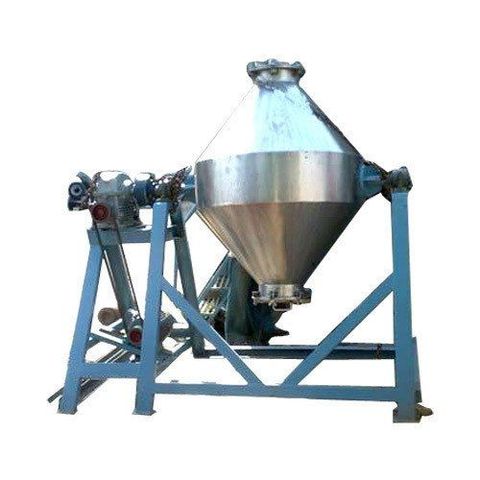
3. Double Cone Blender
This blender uses a rotating double-cone vessel to tumble materials.
Advantages:
- Uniform mixing
- Easy cleaning
- Minimal product degradation
Common applications:
- Pharmaceuticals
- Food products
- Specialty chemicals
4. Paddle Mixer
Paddle mixers use rotating paddles to move materials through the mixing chamber.
Advantages:
- Fast blending
- Handles difficult materials
- Suitable for wet and dry mixing
Common applications:
- Chemicals
- Fertilizers
- Construction materials
5. High-Shear Mixer
High-shear mixers use intense mechanical action to break down particles and create highly uniform mixtures.
Advantages:
- Rapid processing
- Excellent consistency
- Suitable for complex formulations
Common applications:
- Pharmaceuticals
- Advanced chemical production
Comparison Table: Common Powder Mixing Machines
| Mixer Type | Mixing Method | Best For | Key Advantage |
|---|---|---|---|
| Ribbon Blender | Mechanical agitation | Large batches | Versatile and efficient |
| V-Blender | Tumbling action | Fragile powders | Gentle mixing |
| Double Cone Blender | Rotational blending | Fine powders | Easy cleaning |
| Paddle Mixer | Paddle agitation | Dense materials | Fast processing |
| High-Shear Mixer | Intensive mixing | Specialized formulations | High uniformity |
Benefits of Powder Mixing Machines
Modern powder mixing equipment offers several operational advantages.
Improved Product Consistency
Uniform blending helps maintain consistent product quality from batch to batch.
Higher Production Efficiency
Automated systems reduce manual labor and processing time.
Reduced Material Waste
Accurate mixing minimizes rejected batches and production losses.
Better Quality Control
Advanced machines allow manufacturers to maintain precise blending standards.
Scalability
Many systems can accommodate varying production volumes.
Limitations and Challenges
Despite their benefits, powder mixing systems have some limitations.
Initial Equipment Investment
Industrial mixing equipment may require significant upfront costs.
Maintenance Requirements
Regular maintenance is necessary to ensure reliable operation.
Material Compatibility Issues
Some powders may require specialized mixing technologies.
Cleaning Complexity
Certain industries, particularly pharmaceuticals and food processing, require extensive cleaning between batches.
Key Features to Consider
Choosing the right powder mixing machine requires evaluating several important factors.
Batch Capacity
Determine whether the machine can handle current and future production volumes.
Mixing Uniformity
Evaluate the machine's ability to produce consistent blends.
Material Characteristics
Consider:
- Particle size
- Density
- Moisture content
- Flowability
Cleaning Accessibility
Easy-to-clean equipment can reduce downtime and improve operational efficiency.
Automation Options
Modern systems may include:
- Automated controls
- Recipe management
- Process monitoring
- Data recording
Energy Efficiency
Efficient machines can help reduce long-term operating costs.
Powder Mixer Evaluation Checklist
Before selecting equipment, consider the following checklist:
Production Requirements
- Required batch size
- Daily output targets
- Product variety
- Future expansion plans
Material Considerations
- Powder characteristics
- Sensitivity to mixing forces
- Moisture content
- Ingredient compatibility
Operational Factors
- Available floor space
- Cleaning requirements
- Maintenance needs
- Operator training requirements
Financial Considerations
- Equipment cost
- Installation expenses
- Maintenance costs
- Energy consumption
Modern Industrial Blending Methods
Industrial blending technology continues to evolve as manufacturers seek higher efficiency and precision.
Batch Blending
Batch blending remains one of the most common approaches.
Characteristics:
- Materials are processed in separate batches
- Suitable for controlled production environments
- Easier quality verification
Continuous Blending
Continuous blending systems feed ingredients into the mixer without interruption.
Advantages:
- High throughput
- Reduced production delays
- Improved operational efficiency
Automated Blending Systems
Automation technologies help improve consistency and reduce human error.
Features often include:
- Programmable controls
- Real-time monitoring
- Automated ingredient feeding
- Production tracking
Smart Manufacturing Integration
Many facilities integrate mixing systems into broader manufacturing networks.
Benefits include:
- Production data collection
- Predictive maintenance
- Process optimization
- Improved traceability
Latest Trends and Innovations
The powder mixing industry continues to adopt new technologies.
Industry 4.0 Integration
Modern mixers increasingly connect with digital manufacturing platforms.
Benefits include:
- Remote monitoring
- Performance analytics
- Process optimization
Advanced Process Sensors
Sensors provide real-time insights into mixing performance and material conditions.
Energy-Efficient Equipment
Manufacturers are designing machines that consume less energy while maintaining productivity.
Improved Sanitary Designs
Industries with strict hygiene standards benefit from enhanced equipment designs that simplify cleaning and reduce contamination risks.
Automated Cleaning Systems
Some systems now feature clean-in-place (CIP) technology that reduces manual cleaning efforts.
Leading Companies in Powder Mixing Solutions
Several manufacturers are recognized globally for industrial mixing equipment.
| Company | Primary Focus |
| Munson Machinery | Industrial mixers and blenders |
| GEA Group | Food and pharmaceutical processing equipment |
| Hosokawa Micron | Powder processing technologies |
| Charles Ross & Son Company | Industrial mixing equipment |
| Bachiller | Blending and process solutions |
| Amixon GmbH | Precision powder mixing systems |
These companies serve a variety of industries and offer equipment designed for different production requirements.
How to Choose the Right Powder Mixing Machine
Selecting the most suitable mixer depends on operational goals and material requirements.
Define Your Application
Identify:
- Product type
- Production volume
- Quality requirements
Analyze Material Properties
Different powders behave differently during mixing.
Consider:
- Particle size distribution
- Flow characteristics
- Bulk density
- Moisture sensitivity
Determine Cleaning Requirements
Industries with strict hygiene standards may require equipment with easy-access cleaning features.
Evaluate Automation Needs
Automated systems may improve consistency and productivity for high-volume operations.
Consider Long-Term Requirements
Choose equipment capable of supporting future growth and evolving production needs.
Tips for Effective Use and Maintenance
Proper operation and maintenance help maximize equipment performance.
Follow Manufacturer Guidelines
Always follow recommended operating procedures.
Perform Routine Inspections
Inspect:
- Bearings
- Seals
- Drive systems
- Mixing components
Keep Equipment Clean
Regular cleaning reduces contamination risks and maintains product quality.
Monitor Mixing Performance
Track consistency and process efficiency to identify potential issues early.
Train Operators Properly
Well-trained operators can help improve safety and equipment longevity.
Frequently Asked Questions
What is the purpose of a powder mixing machine?
A powder mixing machine combines dry materials into a uniform blend to improve product consistency and manufacturing efficiency.
Which industries use powder mixers?
Common industries include food processing, pharmaceuticals, chemicals, agriculture, cosmetics, and construction materials.
What is the difference between batch and continuous blending?
Batch blending processes materials in separate groups, while continuous blending mixes ingredients continuously during production.
How important is mixing uniformity?
Mixing uniformity is critical because inconsistent blends can affect product quality, performance, and regulatory compliance.
Are powder mixers difficult to maintain?
Maintenance requirements vary by machine type, but routine inspections and cleaning are generally necessary for reliable operation.
What factors influence mixer selection?
Important factors include batch size, material characteristics, production volume, cleaning requirements, and automation needs.
Can one mixer handle multiple products?
Many mixers can process multiple products, although cleaning procedures and material compatibility must be considered.
Conclusion
Powder mixing machines play a vital role in modern industrial manufacturing by helping organizations achieve consistent, high-quality blends across a wide range of applications. From food processing and pharmaceuticals to chemicals and construction materials, effective powder mixing supports productivity, quality control, and operational efficiency.
As blending technologies continue to evolve, manufacturers have access to increasingly sophisticated solutions that offer greater automation, improved monitoring capabilities, and enhanced energy efficiency. Understanding the different mixer types, blending methods, and selection criteria can help businesses make informed decisions that align with their production goals.
By carefully evaluating material properties, production requirements, maintenance needs, and future growth plans, organizations can choose powder mixing equipment that supports both current operations and long-term success.

Related Post...
Explore Industrial Lubricants for Heavy Equipment: Types, Uses, and Insights
Updated: November 23, 2026
Read More
A Guide to Real-Time Simulation in Industrial Machinery and Innovative Machinery Technology
Updated: November 24, 2026
Read More
Understanding Kubota KX121-3 Final Drive Motors: Design, Working, Features and Uses
Updated: November 17, 2026
Read More