Complete Guide to Material Handling Equipment for Warehouses and Manufacturing
Introduction Material handling equipment plays an important role in warehouses, manufacturing facilities, distribution centers, and industrial operations. Businesses regularly need to move raw materials, work-in-progress items, finished products, and packaged goods between storage areas, production lines, loading docks, and shipping departments. Managing these movements efficiently helps maintain workflow, improve workplace organization, and reduce unnecessary manual effort. Material handling equipment includes a wide range of tools and machines, from basic hand trucks and pallet jacks to forklifts, conveyor systems, automated guided vehicles, and robotic handling solutions. Each type is designed for particular loads, distances, working environments, and operational requirements. Choosing the right equipment requires an understanding of material characteristics, facility layout, handling frequency, safety requirements, and operating costs. Equipment that works well in a small warehouse may not be suitable for a large manufacturing plant with continuous production. This guide explores the main types of material handling equipment, their applications, advantages, limitations, recent developments, and practical considerations for selection, operation, and maintenance.
What Is Material Handling Equipment?
Material handling equipment refers to the machines, devices, and systems used to move, lift, transport, position, store, protect, and control materials throughout a facility.
These materials may include raw metals, components, cartons, pallets, chemicals, food ingredients, finished products, and bulk goods. Equipment can support manual operations, powered transportation, automated production, or integrated warehouse management.
Material handling is generally divided into four main categories:
Transportation equipment: Moves materials between locations, such as forklifts and conveyors.
Positioning equipment: Places materials in the correct position for processing or assembly, such as lifting tables and manipulators.
Storage equipment: Organizes materials until they are required, including shelving, pallet racks, and automated storage systems.
Unit load formation equipment: Groups individual items into manageable loads using pallets, containers, stretch wrappers, and related devices.
Some systems perform more than one function. For example, an automated storage and retrieval system can store goods, retrieve them, and transport them to designated collection points.
Main Types of Material Handling Equipment
1. Forklifts
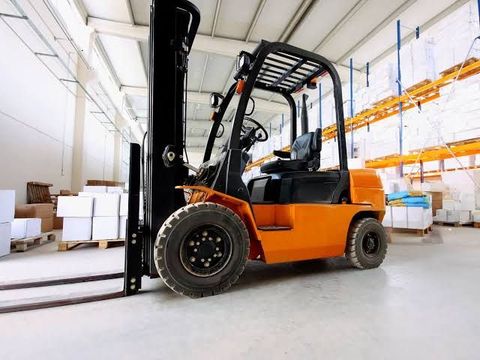
Forklifts are powered industrial vehicles used to lift, carry, and stack materials. They commonly handle palletized goods, machinery components, containers, and other heavy loads.
Counterbalance forklifts are widely used for general material handling, while reach trucks are designed for accessing elevated storage positions in narrower warehouse aisles. Rough-terrain forklifts are intended for suitable outdoor or uneven surfaces.
Forklift selection depends on rated capacity, load dimensions, lift height, turning space, floor conditions, and the operating environment. Electric models are often used indoors, while internal combustion models may be suitable for certain outdoor applications.
2. Pallet Jacks and Hand Trucks
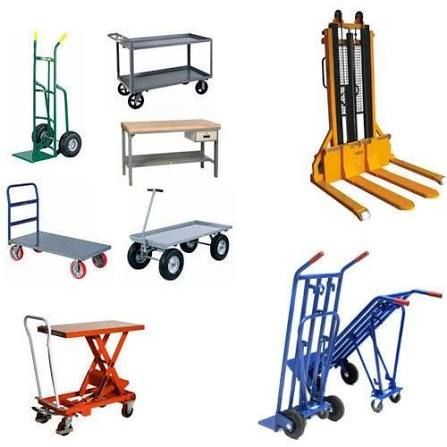
Pallet jacks move palletized loads over relatively short distances. Manual models use a hydraulic lifting mechanism, while powered versions reduce the physical effort required from operators.
Hand trucks and platform trolleys are useful for moving cartons, tools, containers, and smaller items. They are often used in receiving areas, retail stockrooms, workshops, and small warehouses.
These options can be economical for low-volume operations, although their capacity and suitability depend on the load, floor surface, travel distance, and frequency of use.
3. Conveyor Systems
Conveyors transport materials along a defined route. They are common in manufacturing lines, packaging facilities, distribution centers, and sorting operations.
Common conveyor types include:
Belt conveyors: Move cartons, packages, bulk materials, and products along a continuous belt.
Roller conveyors: Transport suitable boxes, trays, and pallet loads using rollers.
Chain conveyors: Move heavier loads or products designed for chain-supported transport.
Screw conveyors: Move certain powders, granules, and bulk materials through a rotating screw mechanism.
Overhead conveyors: Carry materials above the floor, helping preserve ground-level workspace.
Conveyors are useful when materials follow repeated routes. However, they require appropriate layout planning, guarding, maintenance access, and consideration of product dimensions and throughput.
4. Hoists and Cranes
Hoists lift and lower loads using a lifting mechanism. They may be installed as standalone equipment or integrated into overhead cranes.
Overhead cranes move loads across a defined working area and are commonly used in factories, fabrication shops, foundries, and heavy industrial facilities. Gantry cranes use a supporting frame that travels on wheels or rails, depending on the design.
These systems are useful for handling large components, steel sections, machine parts, and other loads that are difficult to move using floor-level equipment.
The required lifting capacity, span, lifting height, duty classification, installation structure, and load-control features must be evaluated before selection.
5. Industrial Trucks and Tuggers
Industrial trucks transport materials around warehouses and manufacturing facilities. Examples include platform trucks, order-picking trucks, and powered tuggers.
Tuggers pull multiple compatible carts or trailers, allowing several loads to be transported in one trip. They are particularly useful in facilities that deliver components to multiple workstations along established routes.
Their effectiveness depends on route design, load stability, traffic management, turning space, and the ability to separate pedestrian and vehicle movements.
6. Storage and Retrieval Equipment
Storage equipment organizes materials and supports efficient access.
Common examples include selective pallet racking, shelving, cantilever racks, mezzanines, vertical lift modules, and automated storage and retrieval systems (AS/RS).
Selective pallet racks provide direct access to individual pallet positions. Cantilever racks are useful for long items such as pipes, timber, and metal sections. Automated systems use mechanical equipment and software to store and retrieve goods according to defined operating instructions.
Storage systems must be designed around load capacity, building height, aisle dimensions, fire protection, inventory characteristics, and access requirements.
7. Automated Guided Vehicles and Autonomous Mobile Robots
Automated guided vehicles (AGVs) follow defined guidance methods to move materials. Autonomous mobile robots (AMRs) use onboard sensing and navigation capabilities to move through suitable environments.
These systems can transport components, totes, and finished goods between storage areas, production stations, and dispatch points.
They may reduce repetitive manual transport, but successful deployment requires suitable floor conditions, charging arrangements, traffic coordination, safety controls, and integration with operational software.
8. Lifting Tables and Vacuum Lifters
Lifting tables raise or lower loads to a suitable working height. They can help position materials for assembly, packing, inspection, or loading.
Vacuum lifters use suction to handle compatible products such as glass sheets, metal plates, cartons, and selected panels. Magnetic lifters are used for appropriate ferrous materials, subject to their rated capacity and operating limitations.
The gripping method must match the material's weight, surface condition, shape, and handling requirements. A lifting solution that works for a smooth panel may not be appropriate for porous, uneven, or fragile products.
Comparison of Material Handling Equipment
| Equipment | Main purpose | Common setting | Important consideration |
|---|---|---|---|
| Forklift | Lift, stack, and transport loads | Warehouses and factories | Capacity and lift height |
| Pallet jack | Move palletized loads | Stockrooms and loading areas | Travel distance and floor condition |
| Conveyor | Continuous or repeated transport | Production and distribution | Throughput and route design |
| Crane and hoist | Lift heavy or suspended loads | Industrial workshops | Load rating and structural support |
| Tugger | Move multiple carts | Manufacturing facilities | Route and traffic management |
| Pallet racking | Store palletized goods | Warehouses | Load ratings and aisle access |
| AGV or AMR | Automated material transport | Modern warehouses and factories | Navigation and system integration |
| Lifting table | Position loads at working height | Assembly and packing areas | Load stability and operator protection |
No single equipment type suits every operation. Many facilities combine several systems to create an integrated material handling process.
Benefits of Material Handling Equipment
Improved Operational Efficiency
Appropriate equipment can reduce the time needed to move goods between storage, processing, and dispatch areas. Conveyors and automated transport systems can support predictable material flow when properly designed.
Reduced Manual Handling
Forklifts, hoists, lifting tables, and powered transport equipment can reduce the need to carry or lift heavy materials manually. This can help control ergonomic risks when equipment is correctly selected and used.
Better Space Utilization
Racking systems, narrow-aisle equipment, and vertical storage solutions can help facilities make more effective use of available floor area and building height.
More Consistent Workflow
Standardized handling routes and repeatable equipment movements can reduce unnecessary travel, material accumulation, and interruptions between production stages.
Improved Inventory Organization
Storage and retrieval systems can help maintain defined locations for goods, support stock tracking, and improve access to materials when integrated with suitable inventory software.
Limitations and Challenges
Despite its advantages, material handling equipment introduces costs and operational responsibilities.
Initial investment: Powered vehicles, cranes, conveyors, and automation systems can require substantial capital.
Maintenance requirements: Moving parts, batteries, motors, hydraulics, and control systems need regular inspection and servicing.
Space constraints: Large equipment may require wider aisles, dedicated travel routes, or structural modifications.
Training requirements: Operators need appropriate training and authorization for the equipment they use.
Downtime risk: Equipment failure can interrupt production or delay order fulfillment.
Integration complexity: Automated equipment may need to connect with warehouse management systems, manufacturing software, or existing machinery.
Safety risks: Poorly controlled lifting, unstable loads, vehicle collisions, and unguarded machinery can cause serious injuries.
A complete cost assessment should include installation, energy, maintenance, training, spare parts, and potential downtime, not just the purchase price.
Applications in Warehouses and Manufacturing
Material handling equipment supports different stages of the supply chain.
Warehousing and Distribution
Warehouses use forklifts, pallet jacks, racks, conveyors, and order-picking equipment to receive goods, store inventory, prepare orders, and load shipments.
High-volume distribution centers may use automated sorting systems, mobile robots, and automated storage solutions to coordinate frequent movements.
Manufacturing and Assembly
Manufacturing facilities move raw materials to production stations and transfer work-in-progress items between operations. Conveyors, hoists, tuggers, lifting tables, and robotic handling systems can support these activities.
The equipment must suit the production sequence, product weight, cycle time, and required positioning accuracy.
Food and Beverage Processing
Food production facilities may use conveyors, bins, pallet-handling equipment, and specialized lifting systems. Equipment selection must consider hygiene, cleanability, moisture exposure, temperature, and applicable food safety requirements.
Construction and Heavy Industry
Construction sites, steel fabrication shops, and heavy industrial facilities use cranes, hoists, forklifts, and suitable lifting attachments to handle large or heavy materials.
Site conditions, wind exposure where relevant, ground stability, load control, and lifting plans are particularly important in these environments.
Pharmaceutical and Electronics Manufacturing
These facilities may require controlled material movement, traceability, and protection against contamination or electrostatic discharge. Equipment and handling methods must be compatible with the specific production environment and its quality requirements.
Latest Trends and Innovations
Material handling technology continues to develop as businesses seek better visibility, flexibility, and control over material movement.
Warehouse Automation
Automated conveyors, robotic picking systems, and automated storage and retrieval solutions can handle repetitive tasks. The level of automation should reflect order volume, product variety, labor availability, and the stability of operating processes.
AI-Assisted Planning
Artificial intelligence and optimization software can help analyze order patterns, suggest picking routes, balance workloads, and identify potential bottlenecks. Results depend on data quality and the suitability of the underlying operating processes.
Connected Equipment and Sensors
Sensors can monitor selected equipment conditions, operating hours, battery status, temperature, and other parameters. Connected monitoring systems can help maintenance teams identify issues earlier when alerts are correctly configured and reviewed.
Energy-Efficient Equipment
Electric forklifts, efficient motors, regenerative braking in compatible systems, and improved battery technologies can reduce certain operating costs and local emissions. The overall environmental benefit depends on usage, charging arrangements, energy sources, and equipment lifecycle.
Flexible Mobile Robotics
AGVs and AMRs can support material movement along changing routes when the facility and safety systems allow it. Businesses should assess navigation reliability, traffic interactions, charging needs, and recovery procedures before deployment.
These technologies are not necessary for every facility. Process improvements and well-organized manual or powered handling can remain appropriate for smaller or lower-volume operations.
Top Material Handling Equipment Companies and Solutions
Several established companies provide equipment for warehousing, manufacturing, lifting, conveying, and industrial automation. The most suitable provider depends on the equipment category, application, technical requirements, and service availability.
| Company | Main area of expertise | Suitable applications |
|---|---|---|
| Godrej Enterprises Group | Forklifts and warehouse material handling | Warehouses, factories, and logistics |
| Toyota Material Handling | Industrial trucks and warehouse equipment | Distribution centers and manufacturing |
| Konecranes | Cranes and lifting equipment | Heavy manufacturing and industrial plants |
| BEUMER Group | Conveyor and automated handling systems | Airports, distribution, and bulk handling |
| Elecon Engineering | Bulk material handling systems | Mining, cement, power, and steel |
| Maschinen Fabrik India | Conveyor systems and bulk handling equipment | Process industries and production facilities |
These companies represent different areas of the material handling industry rather than a universal ranking. Their offerings vary, and not every provider manufactures every equipment category. Compare current product specifications, regional service coverage, spare-parts availability, warranties, and installation support before making a decision.
How to Choose the Right Material Handling Equipment
Choosing equipment begins with understanding the work that needs to be performed. A system designed for occasional pallet movement may not be appropriate for continuous production or heavy industrial lifting.
1. Identify the Material
Consider the weight, dimensions, shape, fragility, and physical properties of the material. Bulk powders, liquid containers, long metal sections, and palletized cartons require different handling methods.
2. Calculate Load Capacity
Determine the maximum load the equipment must handle, including any attachments or accessories that affect its rated capacity. For lifting equipment, confirm the applicable load chart and operating conditions rather than relying only on the maximum advertised rating.
3. Evaluate the Facility Layout
Measure aisle widths, doorways, ceiling height, floor conditions, loading areas, and travel distances. A forklift may need more maneuvering space than a reach truck, while conveyors require a suitable route and access for maintenance.
4. Determine Handling Frequency
Equipment requirements differ between occasional movement and continuous high-volume operations. Repeated movements may justify powered equipment or automation, while lower-volume operations may be adequately served by manual tools.
5. Review Safety and Compliance
Check operator training, machine guarding, load stability, emergency stops, traffic management, and relevant workplace regulations. Equipment must be suitable for the operating environment, including any hazardous-area requirements.
6. Compare Total Operating Costs
Include the purchase price, installation, energy consumption, operator training, preventive maintenance, spare parts, and potential downtime. Automation should be assessed against realistic operational needs and expected long-term benefits.
Checklist Before Purchasing Equipment
Confirm material type, dimensions, and maximum load.
Define required travel distance, lifting height, and throughput.
Check aisle width, floor capacity, and available workspace.
Confirm applicable safety standards and operating requirements.
Review energy use and maintenance needs.
Verify supplier support, spare parts, and warranty terms.
Assess compatibility with existing warehouse or production systems.
Consider future capacity requirements and facility expansion.
Request technical documentation and operator training.
Compare total lifecycle costs across suitable alternatives.
For complex facilities, a material flow assessment can help identify bottlenecks and determine whether equipment changes, layout improvements, or automation would provide practical value.
Best Practices for Operation and Maintenance
Proper maintenance helps preserve equipment reliability and supports safer working conditions. The maintenance plan should reflect the manufacturer's instructions, equipment duty, operating environment, and applicable regulations.
Conduct pre-use inspections. Check tires, forks, chains, brakes, lifting devices, controls, guards, and visible structural components where relevant. Remove defective equipment from service until it has been assessed and repaired.
Train operators. Workers should understand operating limits, load handling, pedestrian awareness, emergency procedures, and equipment-specific controls. Only appropriately trained and authorized personnel should operate equipment requiring such authorization.
Follow preventive maintenance schedules. Inspect hydraulic systems, bearings, motors, belts, chains, batteries, and electrical components according to the manufacturer's recommendations.
Maintain clear travel routes. Keep aisles, exits, loading areas, and emergency access points free of unnecessary obstacles. Separate pedestrian routes from vehicle movements wherever practicable.
Use equipment within its rated limits. Avoid overloading, unstable stacking, unauthorized modifications, and unsuitable attachments. Loads should be secured and handled according to the equipment's operating instructions.
Record inspections and repairs. Maintenance logs help identify recurring faults, monitor equipment condition, and plan replacement before reliability becomes a significant concern.
Review performance regularly. Monitor downtime, maintenance expenses, handling delays, equipment utilization, and safety incidents. These measures can help determine whether existing equipment remains appropriate for the operation.
Frequently Asked Questions
1. What is the most commonly used material handling equipment in warehouses?
Forklifts, pallet jacks, pallet racks, hand trucks, and conveyors are widely used. The specific combination depends on warehouse size, inventory type, load characteristics, and order volume.
2. What is the difference between manual and automated material handling equipment?
Manual equipment relies primarily on direct human effort, such as a hand trolley or manual pallet jack. Automated equipment uses programmed controls, sensors, or navigation systems to perform selected handling tasks with reduced direct intervention.
3. Which equipment is best for heavy loads?
Forklifts, overhead cranes, hoists, and specialized lifting systems may be suitable, depending on the load's weight, shape, movement path, and required lifting height. The equipment's rated capacity and operating conditions must be verified before use.
4. Is automation suitable for small warehouses?
It can be, but automation is not always necessary. Smaller facilities may benefit more from improved shelving, better picking routes, and suitable powered equipment. Automation becomes more attractive when handling volume, repetitive work, or service requirements justify its cost and complexity.
5. How can material handling equipment improve workplace safety?
Suitable equipment can reduce manual lifting, carrying, and repetitive physical effort. However, it introduces other risks, including collisions, crushing hazards, falling loads, and machinery-related injuries. Training, inspections, guarding, and safe operating procedures remain essential.
6. How often should material handling equipment be maintained?
Inspection frequency depends on equipment type, operating intensity, environmental conditions, manufacturer guidance, and legal requirements. Pre-use checks may be necessary daily or before each shift, while detailed servicing follows the applicable maintenance schedule.
7. What factors affect material handling equipment costs?
Costs depend on capacity, technology, dimensions, materials, customization, installation, energy consumption, maintenance, and after-sales support. Automated systems may also require software integration and facility modifications.
8. What is the difference between material handling and material storage equipment?
Material handling equipment moves, lifts, positions, or transfers materials. Material storage equipment organizes materials in designated locations until they are needed. Some systems, such as automated storage and retrieval equipment, perform both functions.
Conclusion
Material handling equipment is an essential part of warehouse management and manufacturing operations. From forklifts and pallet jacks to conveyors, cranes, storage systems, and mobile robots, each equipment category addresses specific material movement and storage requirements.
The right choice depends on load characteristics, facility layout, handling frequency, safety considerations, maintenance resources, and overall operating costs. Although automation and connected technologies can improve selected processes, they should be introduced only when they meet clearly defined operational needs.
A practical approach is to map the movement of materials, identify delays and safety concerns, and compare suitable equipment options before investing. Combined with regular maintenance, operator training, and careful performance monitoring, this approach can help organizations build a more organized, reliable, and efficient material handling operation.

Related Post...
Complete Guide to Material Handling Equipment for Warehouses and Manufacturing
Updated: October 17, 2026
Read More
Comprehensive Guide to Bioreactor Process Control, Automation, and Monitoring
Updated: October 17, 2026
Read More
Understanding Plastic Materials: Types, Properties, and Common Industrial Uses
Updated: October 17, 2026
Read More