How to Choose the Right Industrial Chiller for Manufacturing Facilities
Introduction Industrial chillers play an important role in manufacturing facilities by removing unwanted heat from equipment, production processes, and industrial fluids. Many manufacturing operations generate heat during production, machining, chemical processing, molding, and other activities. If this heat is not controlled, it can affect product quality, equipment performance, production consistency, and operating efficiency. An industrial chiller is a cooling system that removes heat from a process or fluid and transfers it to another medium, such as air or water. The cooled fluid is then circulated through equipment or production systems that require temperature control. Choosing the right industrial chiller involves more than comparing cooling capacities or purchase prices. Manufacturing facilities need to consider heat load, required temperatures, ambient conditions, water availability, energy consumption, installation space, maintenance requirements, and future production needs. This guide explains the main types of industrial chillers, their advantages and limitations, important selection criteria, current developments, and practical maintenance considerations. It is intended to help facility managers, engineers, and manufacturing professionals understand the factors involved in selecting an appropriate cooling system.
What Is an Industrial Chiller?
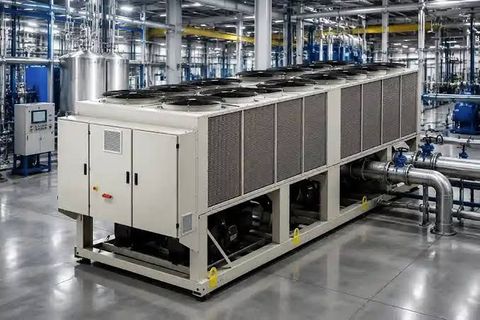
An industrial chiller is a refrigeration system designed to remove heat from a process, machine, or circulating fluid. The system commonly uses water or a water-based solution to transfer cooling to the equipment that needs it.
Most industrial chillers operate through a refrigeration cycle involving a compressor, condenser, expansion device, and evaporator. The refrigerant absorbs heat in the evaporator and releases it through the condenser.
In a typical manufacturing application, a pump circulates chilled water or another compatible fluid through heat exchangers, molds, machinery, or process equipment. The fluid absorbs heat and returns to the chiller, where it is cooled again.
Industrial chillers are used in plastic manufacturing, metalworking, food processing, pharmaceutical production, chemical plants, electronics manufacturing, and many other industries. The appropriate system depends on the process temperature, heat load, operating schedule, and environmental conditions.
Why Manufacturing Facilities Need Industrial Chillers
Temperature control can influence both production quality and equipment reliability. Industrial chillers help maintain suitable operating conditions for processes that generate or absorb significant amounts of heat.
Maintaining Product Quality
Some manufacturing processes require consistent temperatures to produce materials with predictable dimensions, properties, or appearance. For example, plastic molding may require controlled mold temperatures to support consistent cooling and part formation.
Protecting Equipment
Excessive heat can contribute to equipment wear, overheating, and unplanned interruptions. Appropriate cooling helps keep machinery and process fluids within their specified operating ranges.
Supporting Production Consistency
When cooling capacity is insufficient, process temperatures may fluctuate as production demand changes. A correctly selected chiller helps maintain stable conditions throughout the production cycle.
Managing Heat from Multiple Processes
Facilities with several production lines may use a centralized cooling system or multiple smaller chillers. The correct arrangement depends on the location of the equipment, load diversity, temperature requirements, and the consequences of a cooling failure.
Improving Energy Management
An appropriately sized chiller can reduce unnecessary energy use compared with a poorly matched system. Actual savings depend on the equipment, operating conditions, control strategy, and maintenance practices.
Main Types of Industrial Chillers
Industrial chillers are available in several configurations. The main distinction is often how the condenser rejects heat to the surrounding environment.
1. Air-Cooled Chillers
Air-cooled chillers use fans to move outdoor or surrounding air across condenser coils. Heat from the refrigerant is transferred to the air.
These systems are commonly installed where water availability is limited or where a cooling tower would be impractical. They can be suitable for small and medium-sized facilities as well as some larger installations.
Advantages:
Generally do not require a condenser-water cooling tower.
Have relatively straightforward installation arrangements.
Avoid the need for a continuous cooling-tower makeup water supply.
Can reduce the number of water-treatment tasks associated with condenser systems.
Limitations:
Performance can decline in high outdoor temperatures.
Fans and compressors can contribute to noise.
Outdoor placement requires sufficient airflow and clearance.
Energy consumption may be higher than that of a suitable water-cooled system in some operating conditions.
2. Water-Cooled Chillers
Water-cooled chillers reject heat through a condenser-water circuit, usually connected to a cooling tower or another heat-rejection system.
They are often considered for facilities with substantial, relatively steady cooling loads and suitable infrastructure.
Advantages:
Can provide efficient operation under appropriate design conditions.
May suit large industrial cooling requirements.
Can be integrated into centralized cooling networks.
Can perform well when condenser-water temperatures and flow are properly controlled.
Limitations:
Usually require additional equipment, including pumps and often a cooling tower.
Consume water through evaporation, blowdown, and other losses in tower systems.
Require condenser-water treatment and routine cleaning.
Involve additional installation and maintenance requirements.
3. Process Chillers
Process chillers are configured for the temperature, flow, and operating demands of manufacturing equipment. They may be air-cooled or water-cooled and can use different refrigeration technologies.
Applications include injection molding, laser equipment, machine tools, industrial ovens, and specialized production lines.
The term describes the intended application rather than one specific condenser design.
4. Low-Temperature Chillers
Low-temperature chillers are designed for applications that require temperatures below those typically provided by standard comfort or process cooling systems.
They may be used in specialty chemical processing, laboratory production, certain industrial materials processes, and other controlled-temperature operations. The required fluid, refrigerant, insulation, and system configuration depend on the target temperature.
5. Modular and Centralized Chiller Systems
A modular system uses multiple smaller units that can operate together to meet changing loads. A centralized system distributes cooling from one larger plant to multiple production areas.
Modular arrangements may offer flexibility and partial redundancy, while centralized systems can simplify plant-wide monitoring. Neither arrangement is universally better; the decision depends on operating risk, piping layout, load variation, and maintenance strategy.
Comparison of Industrial Chiller Types
| Feature | Air-cooled | Water-cooled | Low-temperature | Modular system |
|---|---|---|---|---|
| Heat rejection | Outdoor or surrounding air | Condenser water and usually a cooling tower | Depends on design | Depends on each module |
| Water requirements | Usually lower | Usually higher | Depends on design | Depends on module type |
| Installation needs | Outdoor airflow and clearance | Chiller, water circuit, and often cooling tower | Specialized temperature design | Space and coordinated controls |
| Typical consideration | Simpler water infrastructure | Large, sustained cooling loads | Specialized low-temperature processes | Variable demand and redundancy |
| Main limitation | Hot ambient conditions | Water treatment and infrastructure | Greater design complexity | Multiple units and controls |
Actual energy use and suitability depend on the specific equipment, climate, process requirements, and operating profile.
Key Factors to Consider When Choosing an Industrial Chiller
1. Calculate the Required Cooling Load
Cooling capacity is one of the most important selection factors. The chiller must remove the heat generated by the production process while maintaining the required fluid temperature.
Cooling load can depend on machine heat output, production rate, material throughput, pump heat, environmental heat gain, and other connected equipment.
A simplified estimate for cooling water is:
Cooling capacity (kW) = mass flow rate (kg/s) × specific heat capacity (kJ/kg·K) × temperature difference (K)
For water, the specific heat capacity is approximately 4.186 kJ/kg·K under ordinary process conditions.
For example, a water flow of 2 kg/s cooled by 5°C represents a heat-removal rate of approximately 41.9 kW, assuming water properties remain close to the stated value.
This is a simplified calculation, not a complete chiller-sizing method. Engineers should account for actual process loads, operating conditions, heat gains, and the appropriate design margin.
2. Determine the Required Supply Temperature
Different manufacturing processes need different cooling temperatures. Some equipment operates with moderately chilled water, while other applications require lower temperatures or tighter temperature tolerances.
Check the equipment manufacturer's specifications and identify the maximum acceptable temperature variation. Avoid selecting a lower temperature than necessary because it can increase energy use and may require specialized equipment or fluid mixtures.
3. Evaluate Ambient Conditions
Outdoor temperature affects the performance of air-cooled chillers and can influence water-cooled systems through cooling-tower conditions.
Facilities in hot climates should verify the chiller's rated capacity at the expected design ambient temperature rather than relying only on standard rating conditions.
Dust, humidity, corrosive atmospheres, and restricted airflow should also be considered when choosing the installation location.
4. Review Energy Consumption
The chiller's electrical demand includes the compressor and may also include fans, pumps, cooling-tower equipment, and auxiliary components.
Compare efficiency at realistic operating conditions rather than at one rating point alone. Seasonal performance, part-load efficiency, and the facility's operating hours can substantially affect total energy use.
5. Consider Water Availability and Quality
Water-cooled systems may require a reliable source of makeup water, appropriate drainage, and water treatment. Hardness, dissolved solids, biological growth, and corrosion risks can affect system performance.
Air-cooled systems usually reduce condenser-water requirements, although process-side water or other fluid may still be necessary.
6. Check Available Space and Installation Conditions
Review the footprint, equipment access, ventilation, structural support, noise limits, electrical supply, piping routes, and service clearances.
A chiller that fits physically but cannot receive sufficient airflow or be maintained safely may cause operational problems.
7. Assess Reliability and Redundancy
If a cooling interruption could stop production or damage materials, consider backup capacity, multiple chillers, critical spare parts, and an appropriate maintenance plan.
A facility may use N+1 redundancy, in which the installed system has one additional unit beyond the number required to meet the design load. Whether this is justified depends on the cost of downtime and the process's risk profile.
8. Compare Total Cost of Ownership
The purchase price is only one part of the overall cost. Include installation, electricity, water, treatment chemicals, maintenance labor, replacement parts, and expected service life.
A lower-priced unit may not be the most economical choice if it consumes more energy or requires frequent maintenance. Conversely, a higher-efficiency model may not recover its additional cost when operating hours are limited.
Benefits and Limitations of Industrial Chillers
Industrial chillers offer several practical benefits, but their performance depends on correct design and operation.
Benefits include:
Controlled process temperatures.
Improved consistency in temperature-sensitive manufacturing.
Protection against overheating within specified equipment limits.
Support for continuous or high-volume production.
Potential energy savings when capacity and controls match the load.
Limitations include:
Initial equipment and installation costs.
Electricity consumption during operation.
Maintenance requirements for compressors, pumps, heat exchangers, and controls.
Water treatment requirements for systems that use cooling towers.
Potential production disruption if the cooling system fails.
A chiller should be assessed as part of the complete process-cooling system, including piping, pumps, controls, and heat-rejection equipment.
Latest Trends and Innovations in Industrial Chillers
Industrial cooling technology continues to develop in response to energy costs, environmental requirements, and demand for better process monitoring.
Variable-Speed Compressors
Variable-speed technology adjusts compressor operation to changing cooling demand. It can improve part-load efficiency in suitable systems, although actual benefits depend on the equipment design and operating profile.
Intelligent Controls and Monitoring
Modern controls can track temperatures, pressures, flow rates, energy use, and fault conditions. Remote monitoring can help maintenance teams identify abnormal operation and plan service activities.
Lower-Global-Warming-Potential Refrigerants
Manufacturers are developing and adopting refrigerant options with lower global warming potential where technically and legally appropriate. Refrigerant selection must consider safety classification, system design, local regulations, and service requirements.
Heat Recovery
Some facilities can recover heat rejected by a chiller for use in hot-water production or other processes. Heat recovery is most useful when a suitable heat demand exists at the right temperature and time.
Integrated Energy Management
Connecting chiller controls with building or factory energy-management systems can help coordinate cooling production, pumping, and other plant equipment. Effective integration requires reliable sensors, suitable control logic, and ongoing performance review.
Manufacturers and Industrial Chiller Solutions
Several established manufacturers offer industrial or process-cooling equipment. Their product ranges, capacities, and regional availability vary.
| Manufacturer | General area of focus | What to compare |
|---|---|---|
| Trane | Commercial and industrial cooling systems | Capacity, part-load performance, service support |
| Carrier | Chillers and refrigeration systems | Temperature range, efficiency, control options |
| Daikin | Chillers and HVAC-related cooling equipment | Available configurations, operating conditions |
| Johnson Controls / YORK | Chillers and industrial cooling solutions | Plant integration, capacity, service requirements |
| Mitsubishi Electric | Cooling equipment and related technologies | Model availability, controls, local technical support |
Public websites:
Trane: https://www.trane.com/
Carrier: https://www.carrier.com/
Daikin: https://www.daikin.com/
Johnson Controls: https://www.johnsoncontrols.com/
Mitsubishi Electric: https://www.mitsubishielectric.com/
This list is illustrative and is not a product ranking or confirmation that every manufacturer offers a suitable model for every industrial process. Check current product catalogues and regional support.
When comparing solutions, request performance data at the required leaving-fluid temperature and design ambient conditions. Confirm the complete system scope, including pumps, controls, condenser equipment, installation requirements, warranty terms, and service availability.
How to Choose the Right Industrial Chiller: A Practical Checklist
Before requesting quotations, prepare the following information:
Required cooling capacity in kW or refrigeration tons.
Process-fluid type and compatibility requirements.
Required supply and return temperatures.
Minimum and maximum operating flow rates.
Expected heat load during normal and peak production.
Ambient temperature and installation environment.
Availability and quality of water.
Electrical supply and power limitations.
Operating hours and expected load variation.
Required redundancy and acceptable downtime.
Space, access, ventilation, and noise restrictions.
Applicable safety, environmental, and industry requirements.
Maintenance support and spare-parts availability.
Estimated lifetime operating and maintenance costs.
Share this information with qualified chiller suppliers or a mechanical engineer so that proposals can be compared on equivalent operating conditions.
Tips for Effective Chiller Operation and Maintenance
Correct maintenance helps preserve cooling capacity, reliability, and energy performance.
Inspect heat exchangers regularly. Clean condenser coils and heat-transfer surfaces according to operating conditions and manufacturer instructions.
Maintain proper fluid flow. Check pumps, strainers, valves, and flow sensors for restrictions or abnormal operation.
Monitor operating temperatures. Record supply and return temperatures to identify changes in process performance.
Check refrigerant systems. Investigate unusual pressure readings, leakage indications, or declining performance through qualified technicians.
Maintain water quality. For water-cooled systems, follow an appropriate water-treatment program and inspect cooling towers and condenser circuits.
Keep airflow paths clear. Remove debris and maintain the required clearances around air-cooled equipment.
Review energy performance. Track electricity use against cooling output where practical, and investigate significant changes.
Follow service schedules. Use the manufacturer's instructions for inspections, component replacement, and safety procedures.
Maintenance frequency should reflect equipment design, operating hours, environmental conditions, and the consequences of failure.
Frequently Asked Questions
1. How do I calculate the chiller capacity required for my factory?
Start by estimating the heat generated by all connected processes and determine the required fluid flow and temperature difference. Include relevant heat gains and peak operating conditions. A qualified engineer should verify the final capacity.
2. Is an air-cooled or water-cooled chiller better for manufacturing?
Neither is universally better. Air-cooled chillers can simplify water infrastructure, while water-cooled systems may offer advantages for larger loads under suitable conditions. Compare total energy use, water availability, climate, installation costs, and maintenance.
3. Can one industrial chiller serve multiple machines?
Yes, if the chiller has sufficient capacity and the distribution system can provide the required flow and temperatures to each machine. Different temperature requirements may justify separate circuits or dedicated chillers.
4. What happens if a chiller is oversized?
Oversizing can increase capital cost and may lead to inefficient cycling or poor temperature control in some systems. Variable-capacity equipment and suitable controls can reduce certain part-load issues, but correct sizing remains important.
5. How long does an industrial chiller last?
Service life varies with design, operating conditions, maintenance, water quality, and component replacement. Manufacturer guidance and maintenance records are more useful than assuming a single lifespan for all systems.
6. How often should an industrial chiller be serviced?
The schedule depends on the model, operating environment, hours of use, and system type. Follow manufacturer recommendations and use operating data and inspections to determine whether additional service is necessary.
7. Can a chiller reduce manufacturing costs?
It can help control process temperatures and may improve energy performance when properly selected and maintained. Actual cost reductions depend on the process, cooling demand, equipment efficiency, and local electricity and water costs.
8. What information should I provide when requesting a quotation?
Provide the required cooling capacity, fluid type, supply and return temperatures, flow rate, design ambient conditions, operating schedule, electrical supply, installation constraints, and redundancy requirements. This allows suppliers to evaluate comparable configurations.
Conclusion
Choosing the right industrial chiller for a manufacturing facility requires a clear understanding of the process, cooling load, operating temperatures, environmental conditions, energy requirements, and reliability needs. Air-cooled, water-cooled, low-temperature, process, and modular systems each serve different purposes, and the best option depends on the facility's actual requirements.
A practical selection process begins with accurate load calculations and verified operating conditions. It then compares suitable equipment, total ownership costs, maintenance needs, and available technical support. Proper installation, monitoring, and preventive maintenance are equally important for long-term performance.
Rather than choosing a chiller based on purchase price or rated capacity alone, manufacturing facilities should evaluate the complete cooling system and its role in production. This approach supports informed decisions, reliable temperature control, and more effective management of operating costs.

Related Post...

Guide to Welding Machines in Fabrication and Construction Industry
Updated: October 17, 2026
Read More
A Comprehensive Guide to Laser Cutting Machines, Their Functions, and Applications
Updated: October 17, 2026
Read More
Hydraulic Crane Designs and Their Role in Industrial Material Handling
Updated: October 17, 2026
Read More